

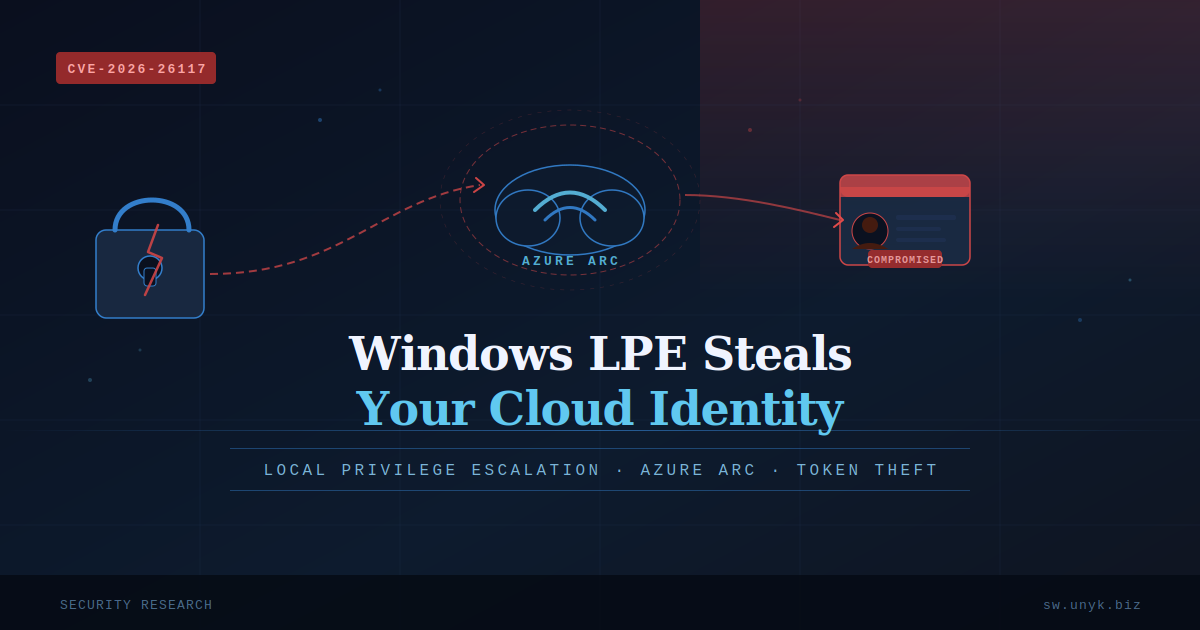
Azure Arc is designed to make hybrid management easier: bring on-prem and non-Azure machines into the Azure control plane for policy, monitoring, and automation. That convenience also creates a new trust relationship between a Windows machine and its cloud identity.
This week, researchers described a chain of issues in Azure Arc agent services on Windows (CVE-2026-26117) that can allow a low-privileged local user to hijack internal agent communications, escalate to NT AUTHORITY\SYSTEM, and potentially abuse the machine’s Azure Arc identity and RBAC permissions. Microsoft fixed it in updated Azure Arc agent components (Arc Agent Services v1.61).
Why this matters
This is bigger than a local escalation bug. Azure Arc gives an onboarded machine a cloud identity. If a local attacker can jump from “standard user” to SYSTEM and then impersonate or hijack that identity, the impact can extend beyond one endpoint.
In the published analysis, the attacker can potentially:
- Escalate from low privilege to SYSTEM
- Take control of the machine’s Azure Arc resource object
- Abuse any RBAC privileges assigned to that machine identity
- Even trick the machine into connecting to an attacker-controlled tenant (in one described scenario)
How the attack works (high level)
The core idea is simple: if internal Windows services start late and communicate in ways that can be intercepted, a low-privileged user may be able to “get there first” and impersonate the service endpoint. In the writeup, several Arc agent services are configured for delayed start, and exploitation relies on a restart (or waiting for one). The attacker can race the services by binding to ports or named pipes first and supplying malicious responses.
What to do this week
1) Patch Azure Arc agent components across Arc-joined Windows machines
If you use Azure Arc, make sure every Arc-joined Windows system is updated to a fixed agent/services version (Microsoft’s fix was released March 10). Treat this as “fleet hygiene,” not “we’ll get to it later.”
2) Review what your Arc machine identities are allowed to do
Assume a machine identity can be compromised. RBAC that is “convenient” can become lateral movement when an identity token is abused. Keep permissions tight and scoped to what is actually required.
3) Treat local privilege escalation as the default step two
Many real-world incidents follow the same pattern:
- Initial access as a normal user (phishing, browser compromise, stolen creds, etc.)
- Privilege escalation to SYSTEM or admin using a vulnerability, misconfiguration, or weak service boundary
You can’t always prevent step one. You can reduce the damage of step two by making sure users don’t start with admin privileges and by shrinking the number of elevated processes attackers can piggyback.
Where Elevator for Windows fits
CVE-2026-26117 is a reminder that “standard user” is not a magic shield: attackers look for a path to SYSTEM. But least privilege still matters because it removes the easiest shortcut: users running as admins all day.
At UNYK, we built Elevator for Windows to help organisations remove standing local admin without breaking the handful of apps that still demand elevation.
- Keep users out of the local Administrators group
- Allow only approved applications to run elevated
- Log elevation events so you can see what still requires admin and where
If you want to pilot controlled elevation with 2–3 stubborn apps:
Start Free 30-Day Trial Request Elevator Pricing
Related reading: Five Myths About Removing Local Admin Rights on Windows